
 Global (English)


Preventing gender-based violence: what companies can do beyond training


Why prevention starts beyond the home
According to estimates published by the World Health Organisation in November 2025, around 840 million women worldwide, nearly one in three, have experienced physical or sexual violence by an intimate partner or sexual violence by other men at some point in their lives. Over the past twenty years, the phenomenon has declined by a mere 0.2% per year.
The picture in Italy is strikingly similar. According to the latest Istat survey on women's safety, conducted in 2025, 31.9% of women aged 16 to 75 have experienced physical or sexual violence at least once in their lifetime.
The Istanbul Convention defines “gender-based violence” as violence directed against a woman because she is a woman, or violence that disproportionately affects women. Its manifestations are varied and often interconnected: physical, sexual, psychological and economic abuse, as well as stalking and coercive control.
“Psychological violence is the foundation of all the others,” explains Tania Berti, psychologist at the Artemisia anti-violence centre in Florence. “Few women would remain in a relationship characterised by physical violence without the underlying psychological abuse. That is the common thread running through every form of violence.”
The workplace intersects with this reality in several ways. First, work itself can be a setting where violence occurs. According to an Istat report published in 2023, 13.5% of women aged 15 to 70 have experienced sexual harassment in the workplace during their lifetime, a figure that rises to 21.2% among women aged 15 to 24.
At the same time, work can represent a vital source of independence and support. For many women experiencing abuse at home, it may be the only space where they maintain trusted relationships, financial autonomy and opportunities to express their skills and potential. Most importantly, the workplace can become the place where warning signs are recognised for the first time, provided that colleagues and managers know what to look for.
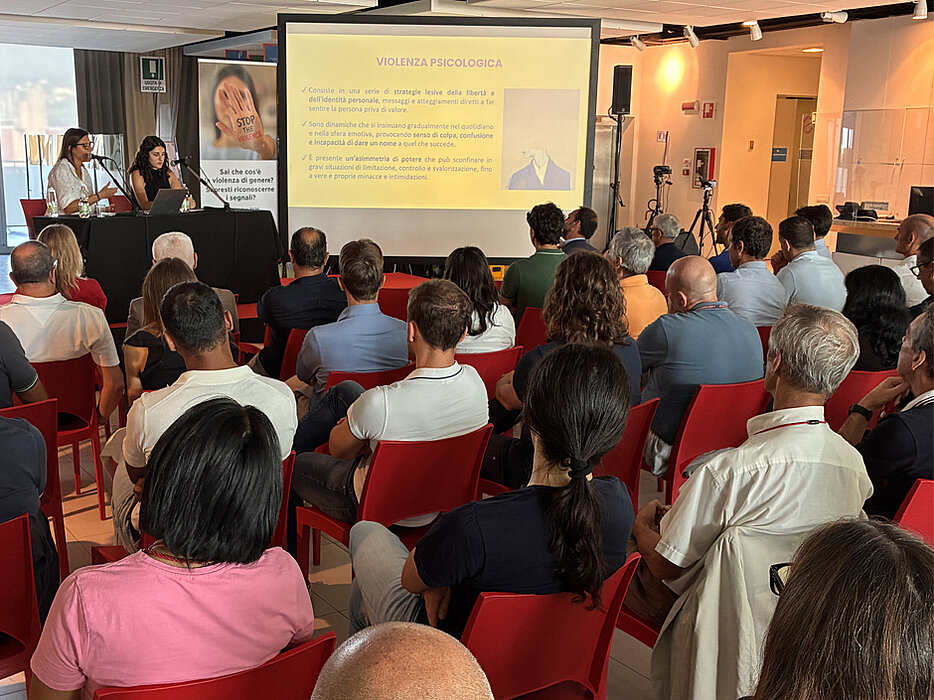
For this reason, the psychologists at the Artemisia anti-violence centre in Florence, with which Esaote has collaborated since 2024, deliver training programmes in schools and workplaces. They recently led a training course for Esaote employees, sharing practical tools to recognize, understand and address gender-based violence.
Their experience highlights an important lesson: while domestic settings are often where violence takes place, awareness and prevention cannot remain confined to the home. Workplaces may seem distant from the issue, yet they are often much closer to it than we imagine.
“It’s a private matter”: where awareness begins
Anyone entering a company to talk about violence against women is likely to encounter the same initial reaction: distance. “There is often a tendency to minimise the issue,” says Alessia Lastrucci, educator at the Artemisia anti-violence centre. “People tend to see it as something that happens behind closed doors, something that affects other people, other social groups, perhaps those with lower levels of education or fewer economic resources. The workplace is not where these conversations belong. It’s not my concern.” This perception is often the starting point of workplace training programmes on gender-based violence.
The attitudes that emerge in the classroom are, in many ways, a reflection of those found in society at large.
“A company is a microcosm of society,” says Tania Berti. The widespread view is that violence is a marginal issue associated with poverty, limited education or substance abuse. Yet the experience of anti-violence centres tells a very different story. Gender-based violence cuts across social, economic and cultural boundaries, affecting women from every background.
At its core lies a problem that is often difficult to recognise, even for those directly experiencing it.
“If I were not familiar with the warning signs of abuse, those behaviours that reveal the direction a relationship is taking, I could easily become a victim myself,” Berti explains. “Recognising violence is not as straightforward as people might think.”
Preventing gender-based violence in the workplace: why training matters
So how can companies address such a complex issue through workplace training?
According to the psychologists at Artemisia, there is no single formula. Training programmes can be tailored to different organisational contexts, from large-scale awareness sessions to smaller workshops. Both approaches can be effective, but they encourage engagement in different ways.
“Small groups and workshop-based activities tend to foster a deeper emotional connection,” explains Alessia Lastrucci. “When people feel safe and comfortable, they are more willing to share experiences, ask questions and reflect on their own assumptions.”
The format also serves an important safeguarding purpose. Companies may include employees who are currently experiencing violence, and discussions on these topics can evoke powerful emotions or bring difficult situations to the surface.
“It is no coincidence that there are always two of us delivering the training,” says Tania Berti. If someone becomes distressed or needs immediate support, one facilitator can step aside to assist that person while the session continues.
Whether delivered to large audiences or smaller groups, training creates opportunities for dialogue and mutual understanding. Listening to colleagues' perspectives helps participants recognise how the same situation can be experienced differently by different people. In turn, this often influences the way employees communicate and relate to one another in everyday working life.
The role of men
Artemisia has increasingly involved men in its activities, promoting the idea that preventing gender-based violence is a shared responsibility.
Lastrucci recalls a recent workshop in which a young father spoke about how uncomfortable he felt when people referred to him as a “househusband” simply because he takes care of his daughter.
“I’m not being a ‘mum dad’. I’m being a father,” he remarked.
Another participant challenged his view, sparking an open discussion between the two. It may seem like a small exchange, but conversations like these can reveal how deeply ingrained stereotypes continue to shape expectations about gender roles, both at home and in the workplace.
Perhaps each of them took away a small but valuable lesson about the power of words, and how comments that seem harmless can sometimes hurt in ways we do not immediately recognise.
Recognising the warning signs: what companies can do
So how can colleagues and managers recognise when someone may be experiencing domestic violence? Certain behavioral changes can signal that a person may be in a vulnerable situation. These can include a sudden decline in performance, visible anxiety around phone calls or messages, reluctance to attend social or work-related events, or a strong need to leave immediately at the end of the working day. Viewed in isolation, such behaviours can easily be misinterpreted as disengagement or a lack of team spirit. Seen in context, however, they may point to something much more serious.
The support a company can offer is often practical rather than complex. It may mean accompanying an employee to her car if an abusive former partner is waiting nearby, adapting work schedules to reduce potential risks, or simply ensuring that she knows where to find help. But every action starts with awareness and the willingness to talk about the issue openly.
“All victims of violence experience shame,” says Tania Berti. “When people see that their workplace is a safe and supportive environment, they are more likely to ask for help.”
Over the years, Artemisia has increasingly been contacted by companies seeking guidance on how to support employees affected by violence. Berti points to Toscana Aeroporti as an example of a long-term commitment. The collaboration began after the tragic murder of employee Michela Noli by her former husband. Initially conceived as a way to support colleagues and help the organisation process its grief, the initiative evolved into a structured awareness and prevention programme involving the airports of Florence and Pisa.
“It is a consistent, mature and informed commitment that lasts all year round,” the professionals at Artemisia explain. “Not only on 25 November or 8 March.”
Financial independence
Economic abuse is another form of violence against women, one that is often underestimated and misunderstood. It is usually identified with being forbidden to work, but it has many other forms. According to a 2023 WeWorld-Ipsos survey, 49% of women in Italy say they have experienced it at least once, rising to 67% among separated and divorced women.
“Many women hold senior positions and earn their own income, yet they do not have a personal bank account” observes Tania Berti, who oversees pathways to independence at Artemisia. In other cases, women only discover during a separation that loans, debts or financial commitments have been taken out in their name without their full understanding or consent.
This is why Artemisia supports the introduction of financial education in schools. Learning how to manage a bank account, create a household budget, evaluate credit agreements or understand the implications of instalment payments should be considered life skills, not specialist knowledge. Gender-based violence can also be prevented through financial education.
Turning commitment into action: Esaote’s training activities
Esaote has also made gender equality and inclusion an integral part of its people strategy. In 2023, the company obtained the UNI/PdR 125:2022 Gender Equality Certification, complementing it with ISO 30415, the international standard for diversity and inclusion.
“Today, companies are expected to safeguard not only the professional growth of their people, but also their well-being and dignity, especially in sectors such as healthcare, where care and responsibility are part of the organization’s mission,” says Gianluca Dardato, Esaote’s Chief Human Resources Officer and Gender Equality Manager.
“Gender-based violence affects society as a whole. It has consequences for people’s physical and mental health, their economic independence and their ability to work. Everyone has a role to play, including companies.” the manager emphasised.
As part of this commitment, Esaote recently hosted a training session on gender-based violence led by the psychologists of Artemisia, following a company-wide programme on inclusive language.
“The trainers succeeded in engaging the audience from beginning to end,” Dardato recalls. The psychologists confirm this and add a detail that struck them: the questions were mainly about prevention. Many participants, both mothers and fathers, asked how to educate their sons and daughters about healthy relationships, respect and equality.
The audit that opens the second three-year cycle of certifications is scheduled for November. “Certification starts a continuous improvement process that encourages organizations to translate principles into concrete actions, strengthen their culture and create an environment where people feel comfortable expressing themselves openly.” says Dardato.
The practical measures include two distinct courses: one on inclusive leadership, reserved for managers – i.e. those who assess performance, assign tasks and make decisions on career progression – and one, as mentioned, on inclusive language, open to the wider workforce.
Esaote has also introduced gender-blind recruitment practices in parts of its hiring process. During the most recent edition of the e-generation Academy, this approach contributed to a significantly higher proportion of female hires.
These initiatives complement long-standing measures designed to support work-life balance, including flexible working arrangements, remote working opportunities, parental leave support and structured return-to-work programmes following maternity leave.
Esaote is also a member of Valore D, the Italian association that promotes gender balance and inclusive workplace cultures by providing member companies with opportunities for networking, training and the exchange of best practices.
Attracting women to STEM disciplines: Esaote’s next challenge
One of the areas where Esaote wants to make further progress is female representation. Today, women account for around 30% of the workforce, a proportion that is reflected at management level as well.
“As a company driven by research and development, we are constantly looking for graduates with STEM backgrounds,” says Gianluca Dardato. “The challenge is that the gender gap often begins much earlier, during the educational journey itself.”
To help address this issue, Esaote partnered with the University of Genoa to establish the Women in STEM scholarship, awarding a female engineering master's student a €5,000 grant and the opportunity to spend six months carrying out research within the company.
The winner was announced during the Genoa Science Festival.
Along the same lines, Esaote collaborated with the association STEMiamoci, bringing two of its Clinical Specialists into local schools to share their professional experiences and encourage young women to explore careers in science, technology and engineering.
Starting from schools
Education is also at the heart of Esaote's support for “Change is Possible: TOGETHER”, a three-year project through which Artemisia works works with students in two lower secondary schools in Florence on topics including conflict management, gender stereotypes and peer relationships.
The choice of age group is intentional. Early adolescence is the time when girls and boys begin to build their first emotional and interpersonal relationships, making it a critical stage for prevention.
“They are familiar with the theory and can talk about emotions,” says Alessia Lastrucci. “What is often more difficult is recognising those emotions within themselves and understanding how they influence relationships.”
Working with the same classes over three years allows educators to build trust and monitor change over time. Anonymous questionnaires administered at the beginning and end of each school year help measure progress, while the data collected throughout the project will contribute to a dedicated research study.
“Prevention and cultural change start from the foundations, so also from education at school as well as at home,” says Dardato, “and Companies have a responsibility towards the communities in which they operate.”
Everyone has a role to play
Compared with ten or twenty years ago, acknowledges Tania Berti, violence against women is discussed more openly today, and an increasing number of men are taking part of the responsibility. Yet gender-based violence, in all its forms, persists, and the hidden dimension of the problem remains vast.
“We must not think that this issue concerns only anti-violence centres. The centres can do their part, but then we need society as a whole: companies willing to hire women re-entering the labour market, and adequate funding to ensure high-quality support services.”
What is needed, she concludes, are companies that choose to be engaged throughout the year. For someone experiencing violence, knowing that their workplace is a place where the issue can be discussed openly, and where support is available, is often the first step towards seeking help.
This article is part of the editorial project 'Technology and empathy: the new story of care with Esaote and PEOPLE', which is a collaboration between Esaote and PEOPLE Magazine.
Read other articles

SUSTAINABILITY
Measuring the environmental footprint of medical devices: Life Cycle Assessment and EPD
An MRI scanner, a multiparameter monitor, a surgical robot, an…

CARE
Telemedicine for remote communities: the healthcare model of Elba Island
"Elba Island is like a mountain range rising from the sea. Beyond the…

TECHVISION
Artificial intelligence in healthcare: how diagnosis, imaging and clinical practice are changing
Artificial intelligence (AI) has become an integral part of many…

TECHVISION
From brain shift to precision: the role of intraoperative MRI in glioma surgery
For decades, neurosurgeons operating on gliomas have long lacked MR…

CARE
Behind the scenes of the medical infrastructure supporting a major sporting event: what it takes to ensure care at the Winter Olympics
The organisation of imaging and healthcare in a multi-venue event such…

